Launch coverage preview
See every rezoning, variance, and staff recommendation — weeks before the permit.
cityminutes.ai extracts structured data from every US planning commission and city council meeting across 3,142 counties, every week. Conditions of approval, community objections, hearing outcomes, staff recommendations — the four fields permit feeds can't carry.
- 3,142
- counties in scope
- 50
- states + DC
- weekly
- refresh cadence
- 4
- wedge fields
Live record inspector
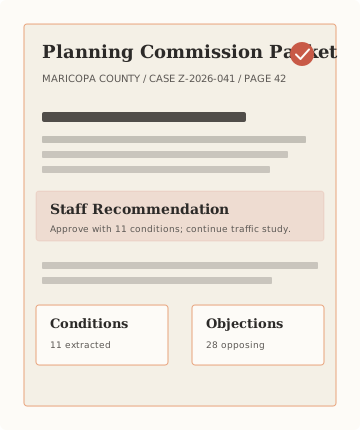
- Staff recommendation
- Approve with conditions
- Community objections
- 28 opposing, school capacity
- Hearing outcome
- Continued to Apr 24
- Maricopa AZFresh
Z-2026-041 / 312-unit multifamily rezone
- Travis TXQA
C14-2026-017 / Data-center CUP with 11 COAs
- Tarrant TXLive
ZC-25-0312 / $4,200/unit traffic condition
The 4-field wedge
The four fields both permit feeds and parcel tools miss.
Shovels, BuildZoom, and ConstructConnect read permits. Regrid reads parcels. None of them extract what actually happens inside a planning commission meeting. We do.
- 01
Conditions of Approval
The numbered conditional clauses a commission imposes on an approved project. Affordable set-asides, traffic impact fees, setbacks, dedications — the 14-condition list that decides whether your pro forma still pencils.
Learn moreFort Worth PC, Mar 18 2026 — 9 conditions on Case ZC-25-0312, including a $4,200/unit traffic fee and a 2-acre park dedication. - 02
Community Objections
Structured opposition signal — speaker name, affiliation, theme, sentiment. When 34 residents file objections citing traffic and school capacity, hearing outcome shifts 22 points vs. baseline. A leading indicator no permit feed can carry.
Learn moreMaricopa PC, Apr 2 2026 — 41 residents on record, 28 opposing a 312-unit multifamily rezone, top theme: school capacity. - 03
Hearing Outcomes
Every vote, every roll call, every continuance. Approval / denial / continuance / withdrawal tagged per case, with commissioner-level vote history. Build jurisdictional base rates the way underwriters build loss curves.
Learn moreWake County PC 2025 — 54% rezonings, 68% variances, 91% subdivisions. Commissioner Martinez 73%, Commissioner Chen 41%. - 04
Staff Recommendations
The planning department's official position — approve, approve-with-conditions, or deny — plus the FAR/density/setback numbers staff recommended. Staff position predicts commission vote ~80% of the time.
Learn moreFranklin County, OH — staff recommended approval with 8 conditions; max FAR capped at 2.5; commission voted yes 6–1.
Built for four teams
The four teams that need to see it first.
Land Committee on Monday morning. Pre-con on a flat bid pipeline. Spec reps frozen out by permit stage. Underwriters reforecasting NOI after a competitor breaks ground next door. Every persona buys the same 4-field wedge for a different reason.
- P1
Land Acquisition
Directors / VPs of Land at top-25 homebuilders, BTR REITs, PE land funds
Your North Dallas manager covers 25+ jurisdictions across 6 agenda systems and defaults to 3–5 real targets while rivals work the other 15.
A Monday digest of every rezoning, staff rec, and COA list in every county you track, ahead of Land Committee.
Learn more - P1B
Pre-Construction BD
VP Pre-Con, Estimating Managers, BD Directors at $100M–$2B commercial GCs
Dodge and ConstructConnect call a project "planning stage" once the permit is already issued — you are the 7th bidder on a race-to-the-bottom RFP.
Architect and owner named during schematic design, 8–18 months before Dodge logs it.
Learn more - P3
Building Products
Architectural sales reps and spec managers at roofing, glass, HVAC, concrete, lighting manufacturers
By permit stage your spec is frozen and you are running lunch-and-learns on dormant firms.
6–18 month early warning on projects you can still get specified into — with the architect-of-record pulled straight from staff reports.
Learn more - P4
Developers & Investors
Commercial / multifamily / industrial / data center developers, real estate PE, REITs, family offices
A 400-unit Class A project 0.6 miles from your asset surfaces the day someone pulls the permit — too late to reforecast NOI.
A live competitive pipeline inside a 3-mile ring with staff-rec and objection signal feeding underwriting.
Learn more
Pipeline
From agenda PDF to structured record in under 48 hours.
Four deterministic stages running every week against every Granicus, CivicPlus, CivicClerk, Legistar, Accela, and NovusAGENDA instance in the country — plus raw PDFs for the 400+ jurisdictions that don't run modern agenda software.
- Step 1
Scan
Weekly pull of agendas, packets, minutes, and staff reports from every Granicus, CivicPlus, CivicClerk, Legistar, Accela, and NovusAGENDA instance — plus raw PDFs.
- Step 2
Extract
LLM-assisted parsing pulls the 4 wedge fields plus case metadata — applicant, parcel ID, proposed zoning, acreage, unit count, FAR. Every extraction links back to its source page.
- Step 3
Validate
Double extraction (LLM + rules-based template) with human QA on disagreements (~11% of 4-field wedge records). Per-field accuracy targets: ≥97% on COA full text, ≥98% on outcomes.
- Step 4
Deliver
Launch review starts with county pages and a 3-county sample. CSV, API, warehouse, and CRM delivery are scoped during implementation so the public site only promises paths the team can actually support.
Nationwide coverage — not 48 states, not 85% of population.
- 3,142
- counties
- 50
- states + DC
- weekly
- refresh
- 4
- wedge fields
Frequently asked questions
Six things every prospective buyer asks before they book a demo.
What does cityminutes.ai actually extract?
Structured conditions of approval, community objections, hearing outcomes, and staff recommendations from every US planning commission, zoning board, and city council — 3,142 counties on a weekly cadence. Every record links back to the canonical source PDF with page number and last-updated timestamp.How is this different from a permit feed like Shovels?
Permit feeds read documents that arrive after a project has cleared planning and zoning. cityminutes reads the meeting packets that decide what the permit is allowed to look like — typically 8 to 24 months earlier. We are 4 fields no permit feed in the market currently extracts: conditions of approval, community objections, hearing outcomes, and staff recommendations.How fresh is the data?
Weekly refresh per county with a 7-day SLA. Most jurisdictions refresh within 24 hours of new agenda publication. Each dashboard shows a freshness badge — green within 7 days, yellow when in flight, red when stale.Which counties are covered today?
The launch site publishes five deep county previews across Maricopa AZ, Travis TX, Tarrant TX, Franklin OH, and Wake NC, with nationwide pages organized around the 3,142-county target coverage map. Current coverage and request paths live on /coverage.How do I get the data into my workflow?
Start with a county page, sample request, or demo review. For production customers, the team can scope CSV exports, API delivery, warehouse drops, and CRM workflows around the same wedge fields without claiming a self-serve integration is already live.Who is this built for?
Four B2B real estate personas: Land Acquisition (homebuilders, BTR REITs, PE land funds), Pre-Construction BD (commercial GCs $100M-$2B), Building Product Specification (architectural sales reps), and Real Estate Developers & Investors (commercial, multifamily, industrial, data center).
Get the feed
Start the feed.
Weekly rezonings, staff recommendations, and conditions of approval — from every planning commission in the country — in your inbox every Monday.